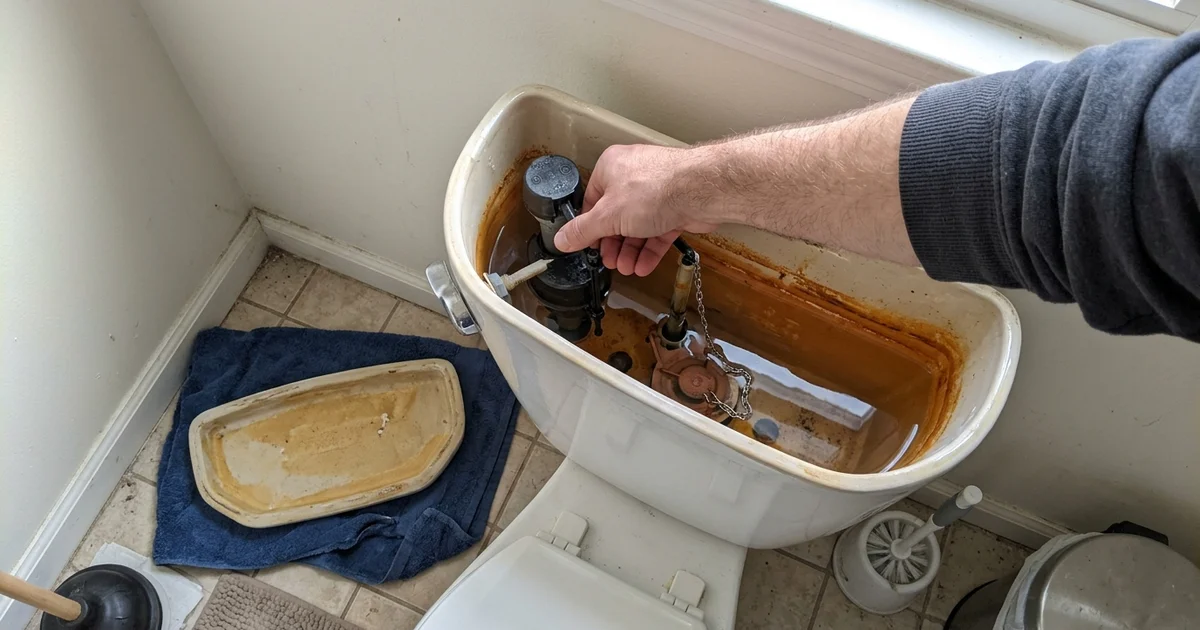
A running toilet is easy to ignore. It is a faint hiss, or a short refill every half hour, and the bathroom still works. But it runs day and night, and the water bill shows it. In a rental sitting empty between tenants, it is one of the most common reasons a landlord gets a bill that makes no sense.
The cause is almost always one of four parts, and you can usually tell which one in about five minutes.
The two-minute dye test
Confirm it first
Put a few drops of food coloring in the tank. Do not flush. Come back in 15 to 20 minutes. If color shows up in the bowl, water is leaking past the flapper or the seat, even if you never hear it.
Watch one full flush
Take the tank lid off, flush, and watch what happens.
| What you see | Likely cause | Who can fix it |
|---|---|---|
| Trickle into the bowl; tank refills on its own | Flapper not sealing | Usually DIY |
| Flapper does not drop fully, or the chain catches | Chain too tight, too loose, or tangled | DIY |
| Water spilling into the overflow tube | Fill valve not shutting off, or float set too high | DIY or plumber |
| New flapper, still leaking | Flush valve seat scaled or pitted | Usually a plumber |
| Water at the base of the toilet | Wax ring or tank-to-bowl seal | Plumber |
| Toilet rocks when you sit | Broken wax seal, possible subfloor damage | Plumber, soon |
The hard-water twist
Everything inside a toilet tank sits in water all the time. Groundwater in Sierra Vista runs moderately hard to hard depending on the well, and over time it affects three parts:
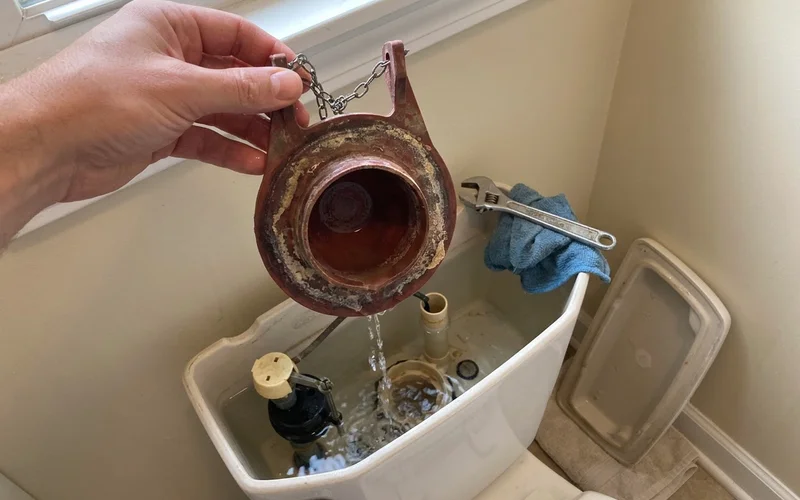
- The flapper stiffens and picks up a thin crust on its sealing edge.
- The flush valve seat, the ring the flapper rests on, scales over and turns rough.
- The fill valve collects deposits on its internal seal and stops closing cleanly.
That is why “I put in a new flapper and it still runs” is such a common complaint. The new rubber is fine. The seat under it is not. It is the same process that wears out faucet cartridges, described in our guide on hard water and fixture wear.
A realistic DIY plan
- Close the stop valve behind the toilet and flush to empty the tank.
- Adjust the chain so it has a little slack, about one or two links, with the flapper closed.
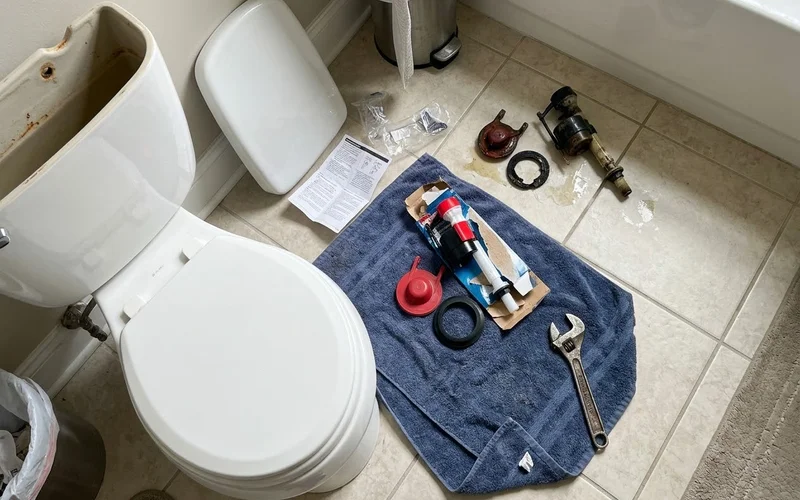
- Replace the flapper. Bring the old one to the store, because 2-inch and 3-inch flappers are not interchangeable.
- Gently scrub the flush valve seat with a non-scratch pad to remove crust.
- Set the float so water stops about an inch below the top of the overflow tube.
- If the fill valve is the problem, a universal replacement is a manageable swap for a handy homeowner.
The moment a DIY job stops making sense
- The stop valve will not close, or it weeps at the stem when you turn it.
- The supply line connections are corroded and you are worried about breaking them.
- The seat is pitted and the flush valve needs replacing.
- There is water at the base, or the toilet rocks.
- You have fixed the same toilet two or three times in a year or two.
A rocking toilet matters more than people think. It breaks the wax seal, which can let water and sewer gas into the subfloor. When a tank has needed repeated repairs, a full rebuild of flapper, fill valve, flush valve, and gaskets, plus a new stop valve, usually makes more sense than another single part.
For landlords and property managers
Do the dye test on every toilet during a turnover, and close the stop valve behind each toilet if the unit will sit empty. A tenant who reports a running toilet is saving you money, so make it easy for them to tell you.
Our fixture repair service covers toilet rebuilds, wax rings, and stop valves. Call Sierra Vista Plumber Pros any hour, in English or Spanish, and request a free estimate. Ask about any service call fee before booking.