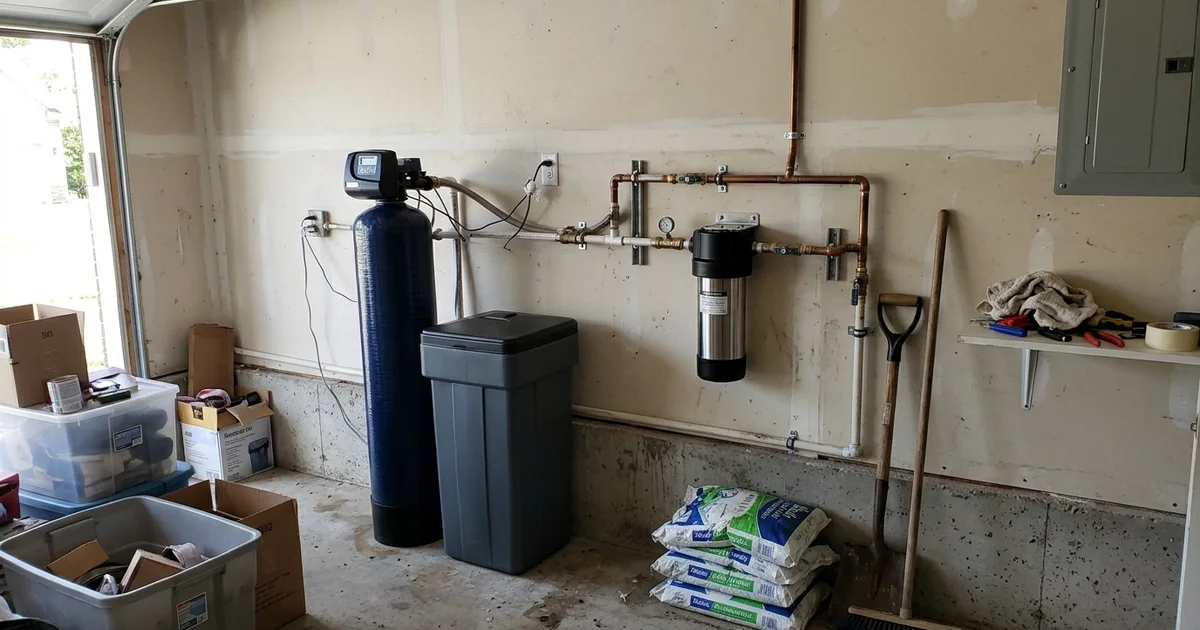
Most of the confusion comes from the label. A “salt-free water softener” sounds like a softener that skips the salt. It is not. It is a different technology doing a different job. Knowing which job you need done is the whole decision.
What each one actually does
A salt-based softener uses ion exchange. Water passes through a tank of resin beads that capture calcium and magnesium and release sodium in their place. When the beads are full, the unit rinses them with brine from a second tank and flushes the hardness down the drain. Water leaving a working softener tests close to zero.
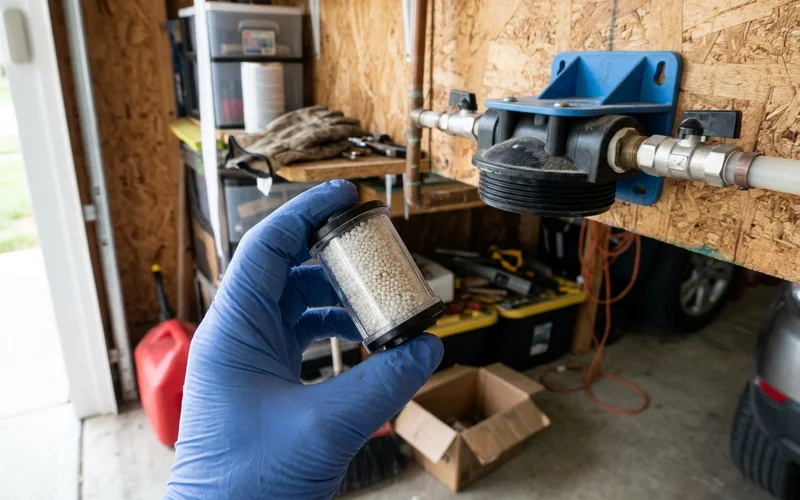
A salt-free conditioner is usually template-assisted crystallization media. As water flows over it, dissolved minerals are nudged into tiny stable crystals that are less likely to cling to pipes and heating surfaces. The minerals are still in the water. A hardness test after the conditioner reads about the same as before it.
One removes hardness. The other changes how hardness behaves.
Your test result decides more than the brochure
Groundwater in the Sierra Vista area runs moderately hard to hard depending on the well, so the same advice does not fit every home. Use your tap reading:
| Your test reads | What usually makes sense |
|---|---|
| Moderately hard | A conditioner can do a respectable job; a softener is still the stronger option |
| Hard | A softener protects heaters and fixtures much more reliably |
| Very hard | A softener, sized correctly; a conditioner will leave noticeable scale |
If hard water has already killed a water heater or keeps seizing valves, choose the system that takes the minerals out.
Head to head
| Criteria | Salt-based softener | Salt-free conditioner |
|---|---|---|
| Removes hardness minerals | Yes | No |
| Hardness reading after treatment | Near zero | About the same |
| Water heater protection | Strong | Partial |
| Spots and crust on fixtures | Largely stop | Reduced, still present |
| Soap and detergent use | Noticeably lower | About the same |
| Existing scale | Slowly dissolves | Stays |
| Upkeep | Salt every few weeks, occasional service | Media change every few years |
| Water used for regeneration | Yes | None |
| Needs a drain | Yes | No |
| Footprint | Resin tank plus brine tank | One compact housing |
When salt-free is genuinely the better fit
- Nobody can manage salt. Forty-pound bags every few weeks are not realistic for every household, including some retirees living alone.
- There is no drain nearby. Softeners need a drain for regeneration. Some installs simply do not have one.
- Space is tight. A conditioner is one slim housing.
- Sodium is medically restricted. The added sodium is small, but an RO tap for drinking water is another way around it.
- Your test reads on the moderate side. The gap between the two narrows.
- You are a renter. A conditioner is simpler to ask a landlord about and has less upkeep to hand off.
Living with each one
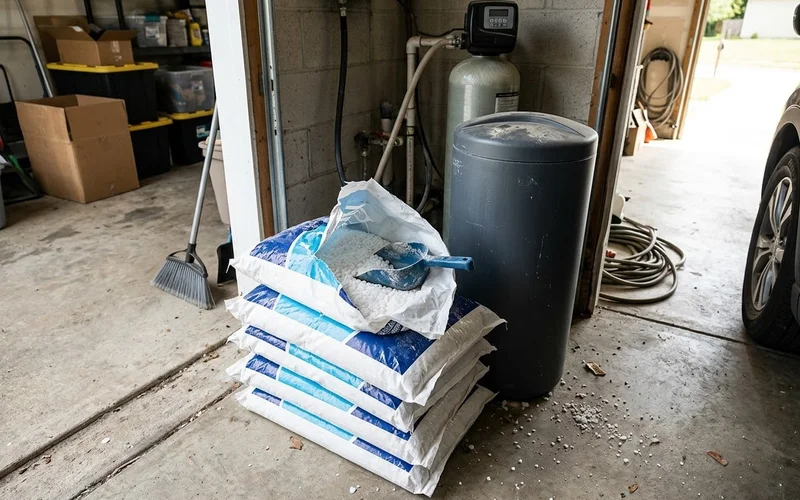
Salt-based: check the brine tank monthly and top it up. The control valve needs occasional attention, and the resin lasts many years if the unit is correctly sized. An undersized unit regenerates too often, uses more salt, and wears out its resin. Our guide on softener sizing walks through the math.
Salt-free: replace the media on the maker’s schedule, typically every few years. Nothing in between.
Freeze note
Whichever you choose, it usually sits near where the main line enters. If that is an unheated garage or an exterior wall, protect the unit and its piping from the short, hard freezes that come on January nights at this elevation.
The short version
On harder well water, a salt-based softener is the system that solves the problem. A salt-free conditioner is a legitimate choice when salt, space, drainage, or a moderate test result points that way, as long as you know it reduces scale rather than removing hardness.
Our water softeners and reverse osmosis service starts with a hardness test at your tap. Request a free estimate from Sierra Vista Plumber Pros, answered around the clock in English or Spanish, and ask about any service call fee before booking.